Guest Post Author: Coat Rack
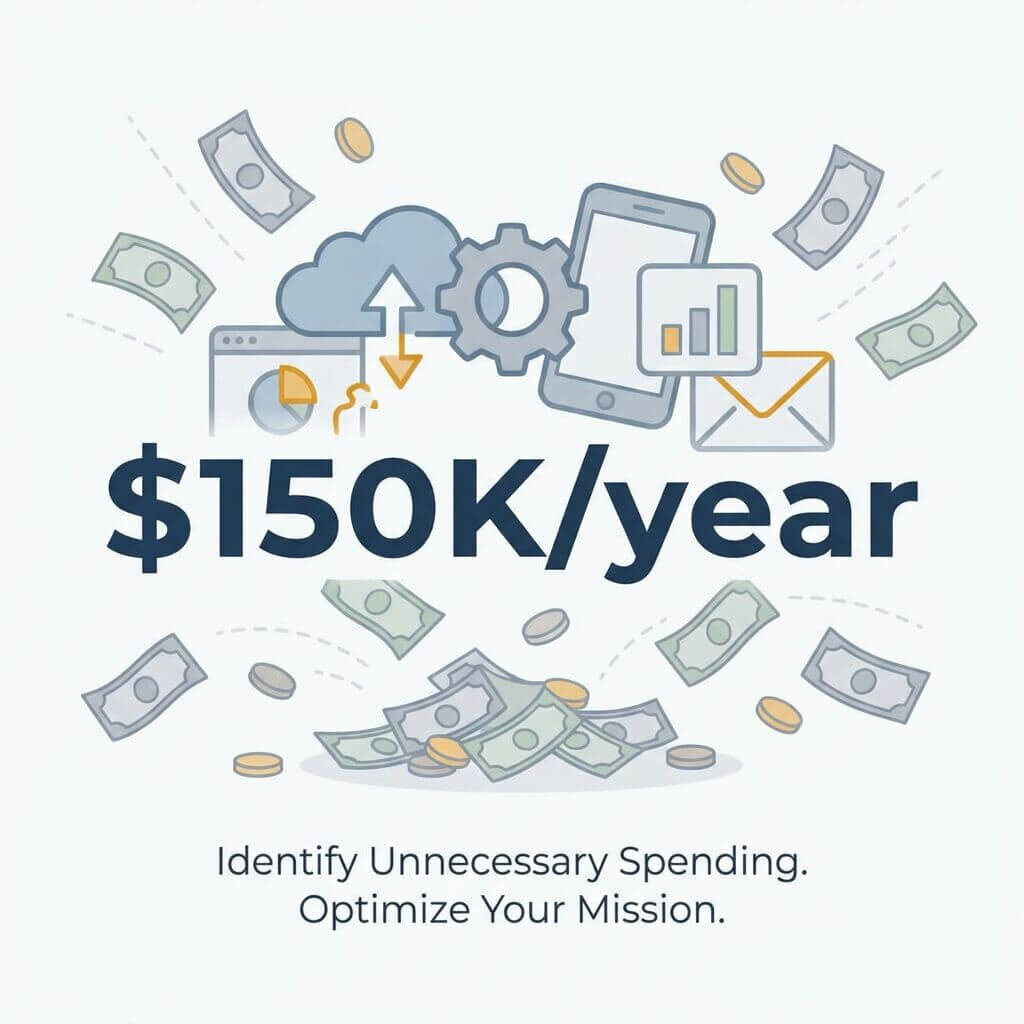
Your organization is probably wasting $150,000 a year on tools you're not using or don't need.
That number comes from both direct research reports (i.e. Zylo's 2026 SaaS Management Index) and a pattern we see over and over at Coat Rack, working with nonprofits across the country. A typical organization running on a $2 million budget has somewhere between 40 and 80 software tools active at any given time. Nobody planned it that way. It happened one subscription at a time, one well-meaning staff member solving one urgent problem at a time.
And almost no one is managing it.
That's not a technology problem. That's a leadership problem. Not in a critical sense — most nonprofit leaders are carrying more than any one person should. But the absence of technology strategy at the leadership table has real financial consequences, and the bill comes due in ways that are hard to see until you're in the middle of a crisis.
Here are three patterns that show up most often.
Mistake 1: Buying tools without a governance plan
SaaS sprawl happens gradually. A program manager needs a project tool. Development wants a donor platform. Communications signs up for a design app. Nobody does anything wrong, and yet within a few years, you're paying for dozens of overlapping subscriptions, some of which nobody on your current team even knows how to use.
The deeper problem isn't the cost, though that adds up fast. It's the confusion. When tools aren't deliberately chosen and governed, they start working against each other. Data lives in too many places. Staff waste time switching between systems. Integrations break and nobody notices for weeks. What started as "we just need a quick solution" becomes a fragmented stack that takes more time to maintain than it saves.
A governance plan doesn't have to be complicated. It's simply an agreement about who decides what tools get added, how they connect to existing systems, and what happens when something stops being useful. Most organizations don't have one.
Mistake 2: Building your data strategy around one person
In many nonprofits, one person carries the institutional knowledge of how data moves. They built the reports. They know where the numbers live. They handle the funder exports, the board dashboards, and the grant compliance pulls.
Then they take vacation. Or they get sick. Or they leave.
When that happens, the data doesn't move. Deadlines get missed. Reports get built manually from scratch, with errors. And somewhere in the background, a funder asks a question in a meeting and nobody can answer it in real time because reporting was never automated.
This is one of the most common and most avoidable risks in nonprofit operations. The fix isn't always technical. Often it starts with a conversation about documentation, cross-training, and what it would actually look like to make data movement less dependent on any single individual. That conversation belongs at the leadership table, not just in the IT department.
Mistake 3: Treating AI adoption as an IT decision
AI is now embedded in the tools most nonprofits already use. It's showing up in CRMs, in email platforms, in grant writing tools, in donor databases. Sometimes it's visible. Often it isn't.
Every contract renewal is now, in some sense, a data governance decision. When a vendor adds AI features to a platform that touches your client data, your donor records, or your program outcomes, that affects how your information is used, stored, and potentially shared. Most nonprofit leaders aren't aware this is happening because AI adoption feels like a technology topic — something to delegate to whoever manages the systems.
It isn't. Decisions about what your organization's data trains, informs, or is exposed to belong at the leadership level. Not because leaders need to understand how the technology works, but because those decisions carry mission, legal, and reputational implications that IT staff can't unilaterally own.
Digitally mature organizations are four times more likely to achieve their mission goals, according to the Salesforce Nonprofit Trends Report. But digital maturity isn't about having the right tools. It's about having the right strategy behind them.
The shift we've seen make the most difference isn't switching platforms or cutting subscriptions. It's simply deciding that technology governance belongs in the room where leadership decisions get made.
You don't need a technical background to lead this conversation. You need to know the right questions to ask.
For a starting point, Coat Rack put together a free guide called "Fail-Proof Your Tech: 5 Critical Mistakes Nonprofits Must Avoid." No sales call required.
About the Author
Coat Rack is a nonprofit technology strategy and governance firm based in Utah. They work with mission-driven organizations nationwide to build future-ready technology plans.